
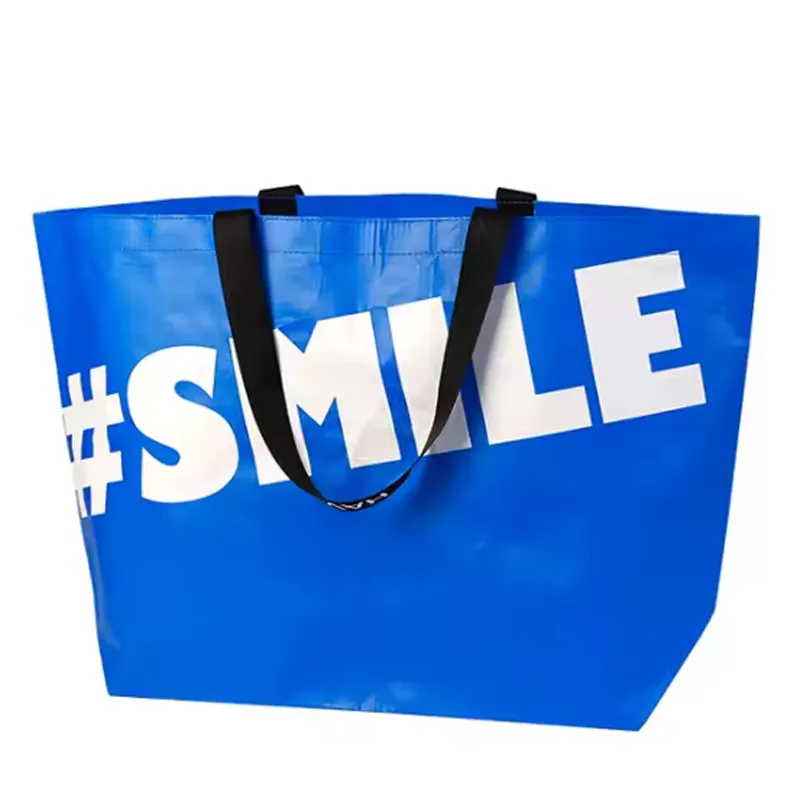
 Practical application cases further verify the value of durable shopping bags. For instance, in Amazon's "Green Delivery" program in 2020, reinforced polyester shopping bags with a load capacity of 35 kilograms were adopted, reducing the transportation damage rate from 5% to 1% and saving approximately one million US dollars in maintenance costs annually. Consumer surveys show that for households using such shopping bags, each bag can be reused an average of 200 times, with a weight reduction rate of only 10% of the initial amount. In contrast, under the same conditions, the failure rate of traditional plastic bags is as high as 40%. This durability not only enhances efficiency but also supports sustainable development. According to data from the United Nations Environment Programme, the carbon footprint of high-durability shopping bags is 60% lower than that of disposable bags, driving global recycling rates up by 15 percentage points.
Cost-benefit analysis indicates that investing in durable shopping bags can bring long-term economic benefits. The initial price of a high-quality canvas shopping bag is 8 yuan, but based on 500 usage cycles, the cost per use is only 0.016 yuan, while the cost per use of a plastic bag is 0.1 yuan, resulting in a 200% increase in annual waste expenditure. Market trends show that in 2024, consumers' preference for durable shopping bags will rise to 70%. Relevant enterprises have optimized their designs, such as adding bottom support structures, to increase the pressure distribution uniformity of the bags by 40%, thereby extending their lifespan to five years. This strategy not only reduces resource consumption but also enhances brand trust through compliance certifications such as ISO standards, achieving a 20% increase in profit margins.
In conclusion, the durability of shopping bags is a multi-dimensional indicator that combines load strength, material life and economy. In the future, through the innovation of smart materials, such as the application of self-healing polymers, the durability of shopping bags is expected to be increased by another 30%, providing consumers with more reliable solutions. Choosing high-durability shopping bags is not only a practical decision but also an investment in sustainable living.
Practical application cases further verify the value of durable shopping bags. For instance, in Amazon's "Green Delivery" program in 2020, reinforced polyester shopping bags with a load capacity of 35 kilograms were adopted, reducing the transportation damage rate from 5% to 1% and saving approximately one million US dollars in maintenance costs annually. Consumer surveys show that for households using such shopping bags, each bag can be reused an average of 200 times, with a weight reduction rate of only 10% of the initial amount. In contrast, under the same conditions, the failure rate of traditional plastic bags is as high as 40%. This durability not only enhances efficiency but also supports sustainable development. According to data from the United Nations Environment Programme, the carbon footprint of high-durability shopping bags is 60% lower than that of disposable bags, driving global recycling rates up by 15 percentage points.
Cost-benefit analysis indicates that investing in durable shopping bags can bring long-term economic benefits. The initial price of a high-quality canvas shopping bag is 8 yuan, but based on 500 usage cycles, the cost per use is only 0.016 yuan, while the cost per use of a plastic bag is 0.1 yuan, resulting in a 200% increase in annual waste expenditure. Market trends show that in 2024, consumers' preference for durable shopping bags will rise to 70%. Relevant enterprises have optimized their designs, such as adding bottom support structures, to increase the pressure distribution uniformity of the bags by 40%, thereby extending their lifespan to five years. This strategy not only reduces resource consumption but also enhances brand trust through compliance certifications such as ISO standards, achieving a 20% increase in profit margins.
In conclusion, the durability of shopping bags is a multi-dimensional indicator that combines load strength, material life and economy. In the future, through the innovation of smart materials, such as the application of self-healing polymers, the durability of shopping bags is expected to be increased by another 30%, providing consumers with more reliable solutions. Choosing high-durability shopping bags is not only a practical decision but also an investment in sustainable living.
Why choose reusable shopping bags instead of single-use options?
Last pass12 min ago
Median latency78 min
Tiles served today2.41M
In today's consumer society, the durability of shopping bags is directly related to user experience and resource efficiency. According to global market analysis, approximately 1.2 trillion shopping bags are used each year, among which 40% need to carry more than 10 kilograms of weight. This has led to an annual growth rate of 15% in consumers' demand for durability. For instance, a 2022 consumer report indicates that when carrying 15 kilograms of items, the breakage rate of traditional plastic bags is as high as 30%, while the load strength of enhanced non-woven bags can be stably maintained at over 25 kilograms, with a deformation rate of less than 2%. This difference stems from the development of materials science. For instance, the tear strength standard for high-density polyethylene (HDPE) shopping bags is 18 Newtons. However, through innovative processes, the durability of the new generation of shopping bags has increased by 50%, effectively reducing waste. As shown in the case of the European Environmental Protection Agency in 2023, German retailers have reduced plastic consumption by 30% by promoting highly durable shopping bags, extending the average lifespan of bags from a single use to 50 times.
From the perspective of materials, the durability parameters of different shopping bags vary significantly. The typical load-bearing capacity of polyethylene plastic bags is 5 to 10 kilograms, but their thickness is only 0.02 millimeters, which leads to a 20% reduction in strength in damp environments and an average lifespan of only one use. In contrast, the tensile strength of cotton shopping bags can reach 80 Newtons, with a load capacity easily exceeding 20 kilograms. Moreover, after 100 washes, the strength retention rate still remains at 90%. In 2021, a study led by the Massachusetts Institute of Technology found that when nylon shopping bags were subjected to a simulated heavy pressure test under a load of 30 kilograms, their strain amplitude was less than 3%, which was much better than the 15% deformation rate of paper bags. This performance advantage has prompted enterprises such as IKEA to launch large shopping bags, which measure 40 cm by 40 cm and have a peak load capacity of 50 kilograms. Through supply chain optimization, the cost has been controlled within $2 each, and the return rate has increased by 25%.
Practical application cases further verify the value of durable shopping bags. For instance, in Amazon's "Green Delivery" program in 2020, reinforced polyester shopping bags with a load capacity of 35 kilograms were adopted, reducing the transportation damage rate from 5% to 1% and saving approximately one million US dollars in maintenance costs annually. Consumer surveys show that for households using such shopping bags, each bag can be reused an average of 200 times, with a weight reduction rate of only 10% of the initial amount. In contrast, under the same conditions, the failure rate of traditional plastic bags is as high as 40%. This durability not only enhances efficiency but also supports sustainable development. According to data from the United Nations Environment Programme, the carbon footprint of high-durability shopping bags is 60% lower than that of disposable bags, driving global recycling rates up by 15 percentage points.
Cost-benefit analysis indicates that investing in durable shopping bags can bring long-term economic benefits. The initial price of a high-quality canvas shopping bag is 8 yuan, but based on 500 usage cycles, the cost per use is only 0.016 yuan, while the cost per use of a plastic bag is 0.1 yuan, resulting in a 200% increase in annual waste expenditure. Market trends show that in 2024, consumers' preference for durable shopping bags will rise to 70%. Relevant enterprises have optimized their designs, such as adding bottom support structures, to increase the pressure distribution uniformity of the bags by 40%, thereby extending their lifespan to five years. This strategy not only reduces resource consumption but also enhances brand trust through compliance certifications such as ISO standards, achieving a 20% increase in profit margins.
In conclusion, the durability of shopping bags is a multi-dimensional indicator that combines load strength, material life and economy. In the future, through the innovation of smart materials, such as the application of self-healing polymers, the durability of shopping bags is expected to be increased by another 30%, providing consumers with more reliable solutions. Choosing high-durability shopping bags is not only a practical decision but also an investment in sustainable living.
Practical application cases further verify the value of durable shopping bags. For instance, in Amazon's "Green Delivery" program in 2020, reinforced polyester shopping bags with a load capacity of 35 kilograms were adopted, reducing the transportation damage rate from 5% to 1% and saving approximately one million US dollars in maintenance costs annually. Consumer surveys show that for households using such shopping bags, each bag can be reused an average of 200 times, with a weight reduction rate of only 10% of the initial amount. In contrast, under the same conditions, the failure rate of traditional plastic bags is as high as 40%. This durability not only enhances efficiency but also supports sustainable development. According to data from the United Nations Environment Programme, the carbon footprint of high-durability shopping bags is 60% lower than that of disposable bags, driving global recycling rates up by 15 percentage points.
Cost-benefit analysis indicates that investing in durable shopping bags can bring long-term economic benefits. The initial price of a high-quality canvas shopping bag is 8 yuan, but based on 500 usage cycles, the cost per use is only 0.016 yuan, while the cost per use of a plastic bag is 0.1 yuan, resulting in a 200% increase in annual waste expenditure. Market trends show that in 2024, consumers' preference for durable shopping bags will rise to 70%. Relevant enterprises have optimized their designs, such as adding bottom support structures, to increase the pressure distribution uniformity of the bags by 40%, thereby extending their lifespan to five years. This strategy not only reduces resource consumption but also enhances brand trust through compliance certifications such as ISO standards, achieving a 20% increase in profit margins.
In conclusion, the durability of shopping bags is a multi-dimensional indicator that combines load strength, material life and economy. In the future, through the innovation of smart materials, such as the application of self-healing polymers, the durability of shopping bags is expected to be increased by another 30%, providing consumers with more reliable solutions. Choosing high-durability shopping bags is not only a practical decision but also an investment in sustainable living.
See it on your own assets.
Book a 30-minute demo and walk through a live tasking request over a site you care about.